Who can see what
A user sees another user's data by changing a number in the address. A scanner does not know what "another user" means.
penetration testing with artificial intelligence
We test web applications, APIs, mobile apps, cloud and infrastructure with AI-assisted analysis, inside a scope you have authorised in writing. Whoever commissions the test receives evidence for every vulnerability, and no report leaves without review.
penetration testing and vulnerability assessment
A vulnerability assessment finds and ranks the vulnerabilities of applications, APIs and infrastructure: it produces a prioritised inventory. A penetration test goes further and proves that a vulnerability can be exploited, and with what impact. ExploitFinder performs both, with AI-assisted analysis and a final review by people.
Results are verified by people before they enter the report: the vulnerability assessment does not stop at a scanner-generated list, and the penetration test does not deliver hypotheses, but reproduced vulnerabilities with severity and a fix.
the context
Your client asks for evidence, not a generic PDF. These are the classes of vulnerability automated tests rarely find. They are hypotheses: the public benchmark will show whether and how far they hold.
A user sees another user's data by changing a number in the address. A scanner does not know what "another user" means.
A discount applied twice, an order paid with a modified amount.
A minor error and a weak configuration can together give full access.
services
An OWASP test, an API test and an access test are not done the same way and do not cost the same. Each service has its own sheet.
The most common risk categories in web applications.
Object-level authorisation, authentication, exposed data.
Package analysis and tests on a test device.
Identity, permissions, storage and logging on AWS, Azure and Google Cloud.
Exposed services, versions, TLS and segmentation, external and internal.
Who can do what across roles, users and steps of a flow.
how it works
Domain, test roles and time window, written and signed.
A DNS check of the domain. Without verification, no test runs.
Recon, plan, controlled tests and attack chains. Every action goes into the log.
A person checks every finding. Only then is the report prepared.
the platform
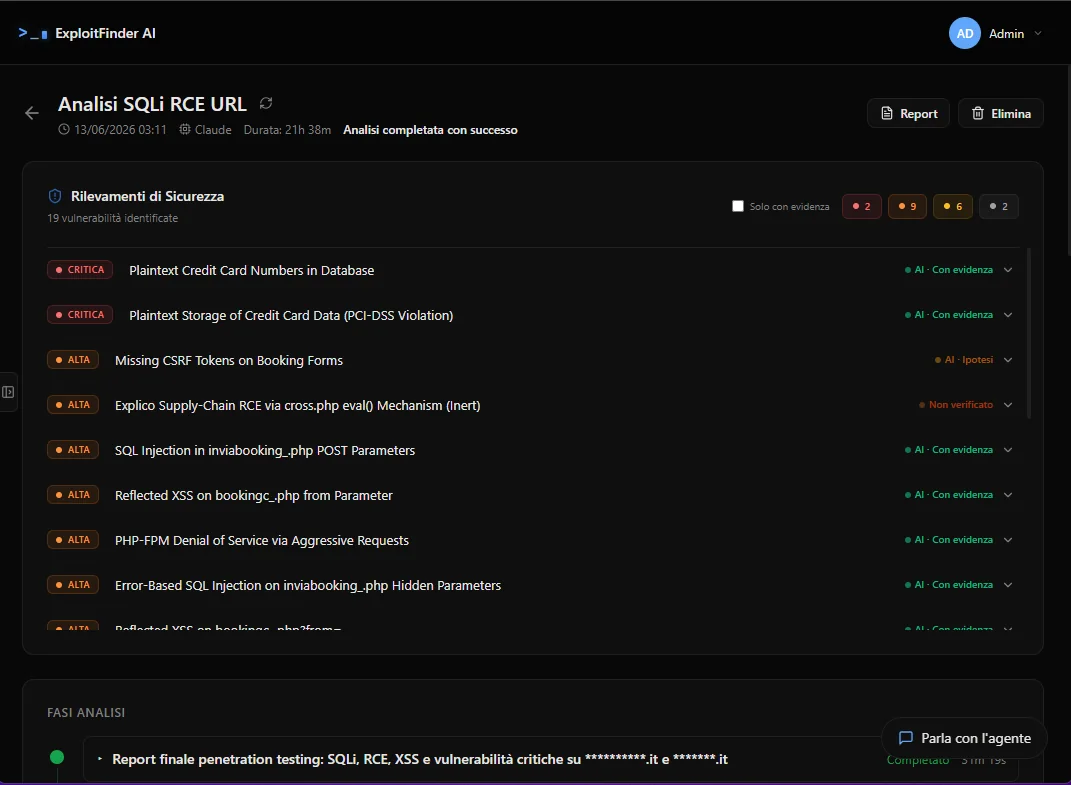
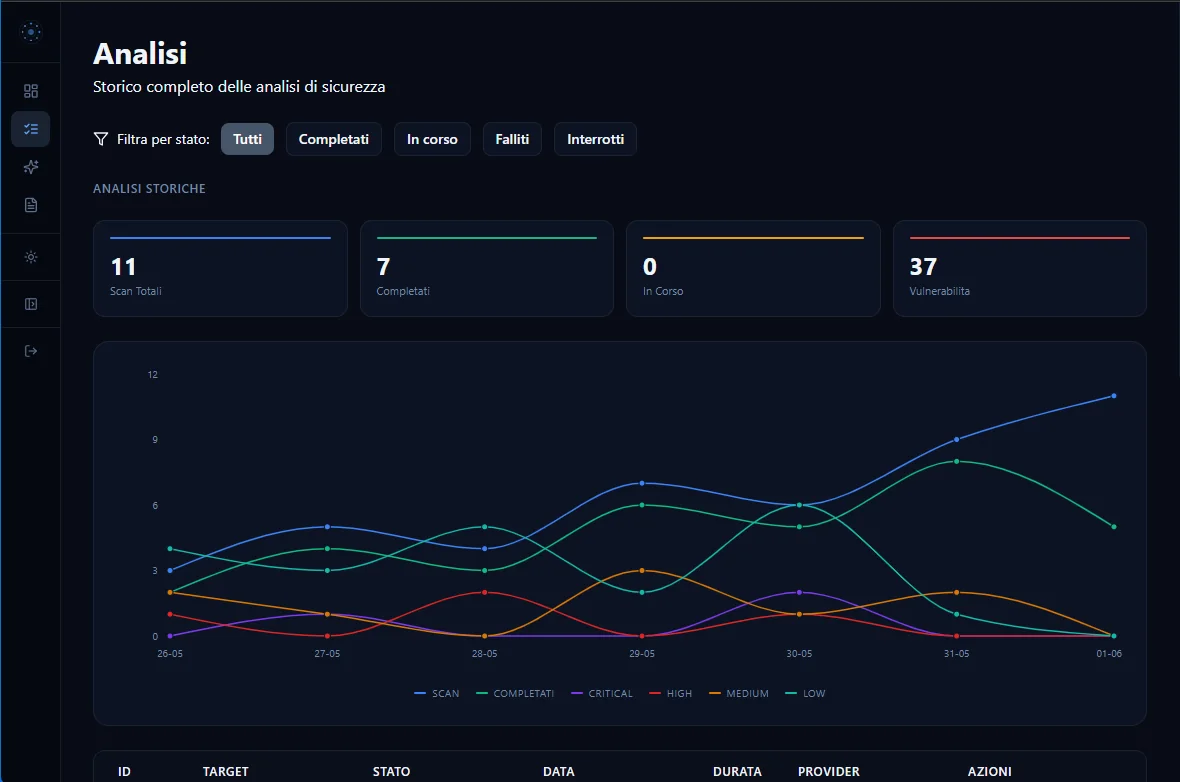
Every test begins by naming the target, which must fall within an authorised scope. You can set a priority (IDOR/BOLA, SSRF, RCE), add instructions and, if needed, provide authentication.
sample report
A 69-page report generated by the ExploitFinder engine on a public, deliberately vulnerable test application (testphp.vulnweb.com). It shows the structure, level of detail and traceability of a complete report.
Overall risk, methodology and results on a page that non-technical readers can follow.
An evidence register and technical sheets for each vulnerability, with the steps to repeat it.
Fix tracking, residual risk and a risk acceptance declaration.
Download the sample report (PDF, 69 pages)
an example
This is how a cross-role access check looks: every line is a recorded step, and the last one waits for a person.
what the AI automates
who it is for
You deliver applications to SMEs or public bodies, and they ask for a security proof for a tender or a renewal.
You resell the proof to your clients, with the same signed scope and the same log.
compliance
We produce the evidence. The judgement stays with whoever certifies or audits.
Evidence of control monitoring and vulnerability detection.
Penetration testing for requirement 11.4.
Vulnerability management and security testing.
Regular testing of technical measures, Article 32.
Vulnerability handling and verification of effectiveness.
how to start
You give us the domain and the reason: certification, client or tender. Within 24 working hours you receive in writing the scope, method, timing and price.
One verified application, compared with the scanner you already use. The €490 is deducted from the first service you buy within 60 days.
Testing with a signed scope, human review and a report with reproducible evidence for every vulnerability.
questions
It depends on the service: from €1,000 to €7,500, indicative and confirmed in the written proposal. The first step is a written quote within 24 working hours, with no obligation. Prices by service are on the Pricing page.
We do not run denial-of-service tests. The time window, hosts and prohibitions are written into the signed scope before the start, and one command halts active tests immediately.
A scanner compares the system with known signatures. We use one, and we also check access between roles, business logic and attack chains, which signatures do not see. A person reproduces every result.
A report that technical staff and management can read, with reproduction steps, severity and a fix for every vulnerability, the action log and, when an auditor needs it, a scope letter.
Yes. Before any test you sign a declaration that the domain is yours or that you have the right to test it. Without a signature, the test does not start.
The system reports it immediately and suspends that line of testing, which resumes only after a person confirms.
The contract states where data is processed and with which model. For clients with data constraints, an option with a model in the European Union or running locally is planned.
It depends on the service and the scope. The duration is written in the proposal, before work starts.
We reply by hand within 24 working hours, with a written proposal or a clear reason.